01
Choose a risk envelope
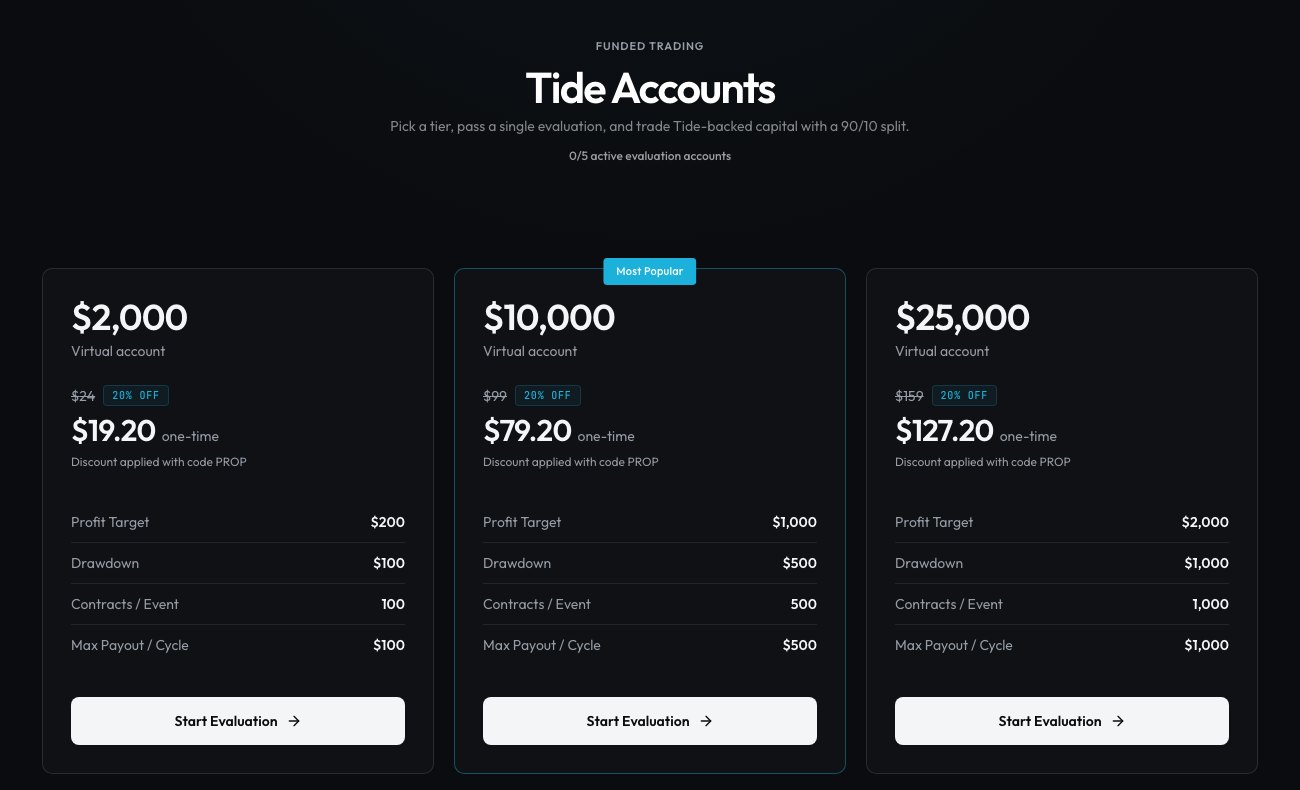
Select a $2K, $10K, or $25K virtual account. A larger headline balance comes with a larger absolute target, drawdown allowance, contract cap, and payout ceiling.
Funded Accounts
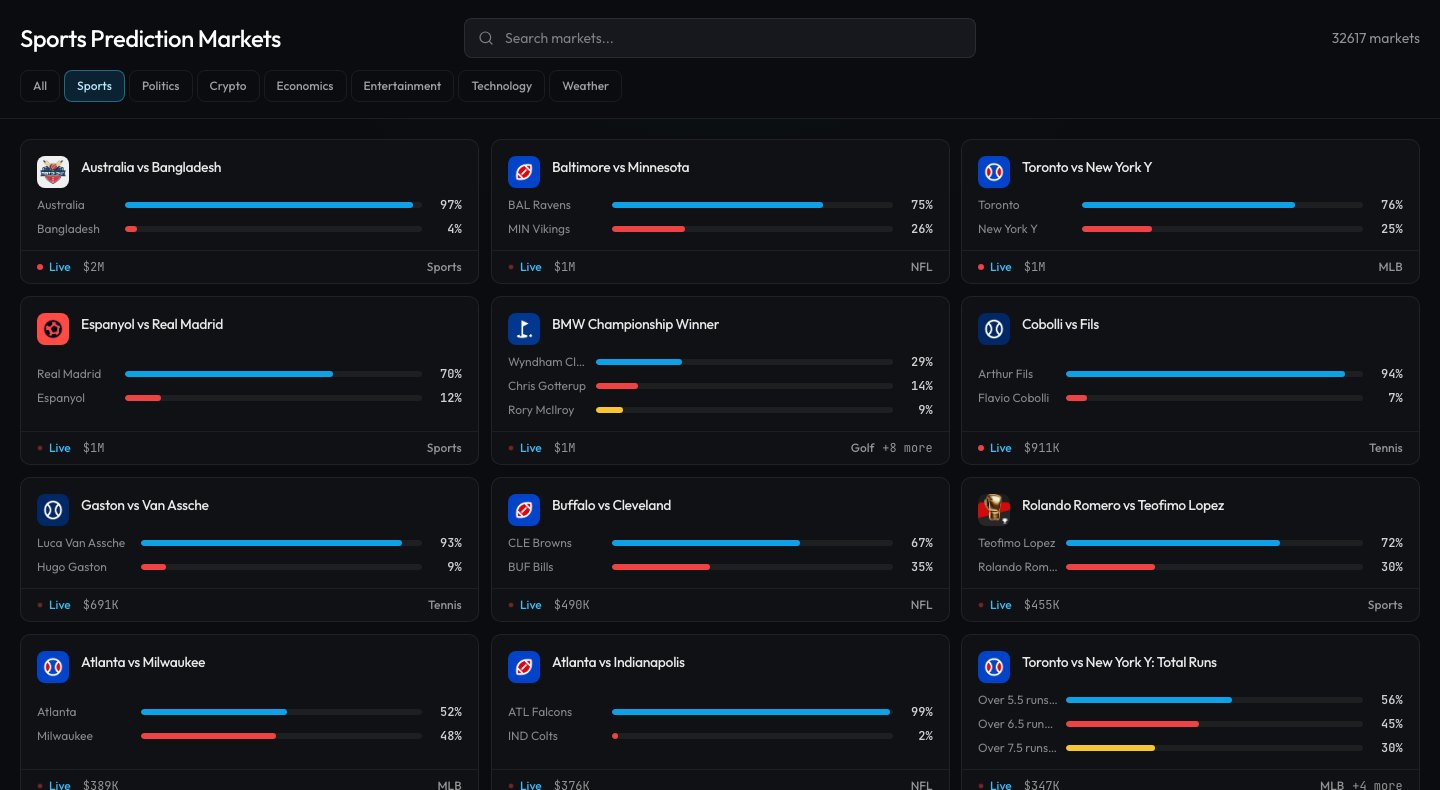
A funded prediction market account gives a trader a way to prove risk control before trading with backed capital. PropTide focuses that model on live Kalshi-powered prediction markets.
In brief
The facts to understand before comparing account sizes or paying for an evaluation.
An evaluation account is virtual; a funded account is the phase unlocked after the published target and trading-day requirements are met.
PropTide uses live Kalshi market prices, a one-phase evaluation, three profitable days, and contract-based position limits.
Funded traders keep 90% of eligible net realized profit, subject to the payout buffer, consistency, and per-cycle limits.
The operating model
01
Select a $2K, $10K, or $25K virtual account. A larger headline balance comes with a larger absolute target, drawdown allowance, contract cap, and payout ceiling.
02
Reach the target after fees, stay above the trailing drawdown floor, and record three profitable trading days at the tier minimum. There is no second verification phase.
03
After passing, activate the funded account and trade under the funded contract limits. Eligible payouts use a 90/10 trader split and a three-day cycle.
01
The account size is a virtual starting balance used to measure targets, drawdown, and funded performance. It is not a cash deposit and it is not an amount the trader can withdraw. The amount at risk during the evaluation is the one-time evaluation fee shown before checkout.
The practical question is not simply which balance is largest. A trader should compare the absolute loss allowance, the amount of profit needed to pass, and the number of contracts allowed in one event. The $10K tier, for example, starts at $10,000, passes at $11,000, and begins with a $9,500 drawdown floor.
02
A pass requires both the profit target and three qualifying profitable days. On the $10K account, each qualifying day needs at least $250 in realized net profit after fees. Open profit does not count toward the daily requirement until the position closes or settles.
The target is evaluated after trading fees. This prevents a high-turnover strategy from appearing profitable before execution costs. Traders can use any eligible market category, but position limits apply by event so that several related contracts cannot be used to hide concentrated exposure.
03
The published floor equals the highest settled end-of-day balance minus the tier's drawdown amount. It can move upward after a profitable day, but it does not move back down. During the day, PropTide checks total account value—cash plus the live value of open positions—against that floor.
Suppose a $10K evaluation finishes a day at $10,400. Its $500 drawdown allowance moves the published floor from $9,500 to $9,900. If the next day's total account value falls below that floor long enough to confirm a breach, the evaluation fails. A brief unreliable quote is not treated as a confirmed loss; the complete operational rule is maintained on the evaluation-rules page.
04
The funded phase uses smaller initial per-event contract limits than the evaluation. This reduces concentration while a new funded track record is established. The limit permanently increases after the account reaches its tier's unlock balance.
Payouts are based on net realized profit, not gross winning trades. A trader needs three winning days and must satisfy the first-payout threshold. The amount available in one cycle is capped by both the tier ceiling and 50% of the balance above the starting balance, while the required withdrawal buffer must remain after the payout.
Current rules
| Account | Fee | Target | Drawdown | Profitable day | Contracts / event | Cycle max |
|---|---|---|---|---|---|---|
| $2,000 | $24 | $200 | $100 | $50 | 100 | $100 |
| $10,000 | $99 | $1,000 | $500 | $250 | 500 | $500 |
| $25,000 | $159 | $2,000 | $1,000 | $500 | 1,000 | $1,000 |
Fees shown are standard list prices before any valid checkout discount. Rules are summarized; the complete rulebook controls.
Economics
For 100 contracts at 40¢, the published evaluation formula is 0.07 × 100 × 0.40 × 0.60.
$1.68
Fees are rounded up to the next cent. A supported resting order uses the lower maker coefficient; actual fills determine which rate applies.
Try the prediction market fee calculatorAt a $10,800 balance with $800 net realized profit and no prior payouts, the 90% entitlement is $720. The excess-balance cap is $400, the cycle ceiling is $500, and the withdrawal buffer leaves $300 available.
$300 after applying all amount limits
Assumes the account also meets winning-day, consistency and timing requirements. The 90% share is applied before the caps, not again after them.
Show the math
Assume a current $10K funded account has a $10,800 balance, $800 of net realized profit, no previous payouts, and satisfies the time, winning-day and consistency requirements.
The $300 buffer limit controls this example. The 90% profit share is already included in the $720 entitlement; it is not applied again to the capped payout. Your account's eligibility and ledger determine the amount available.
Inside the product
| Compare | Evaluation phase | Funded phase |
|---|---|---|
| Purpose | Demonstrate target and risk control | Trade a backed account for eligible payouts |
| Capital | Virtual evaluation balance | PropTide-backed account allocation |
| Profit requirement | Tier target plus three qualifying days | No pass target; payout eligibility rules apply |
| Profit split | Not applicable | 90% trader / 10% PropTide |
| Position limits | Evaluation contract cap | Lower initial cap with a permanent unlock level |
It is an account structure where a trader first passes an evaluation, then trades with backed capital under published risk and payout rules.
No. PropTide evaluations are designed around an evaluation fee and a virtual account balance, not a deposit of trading capital.
A large trade can contribute to the profit target, but it cannot replace the three separate profitable-day requirement. Position and drawdown limits also continue to apply.
An evaluation fee purchases access to that attempt. Review the current checkout terms and refund policy before buying.
A trader may hold up to five active evaluations and five active funded accounts, subject to the current multi-account rules.
Yes. Total account value includes cash and the live value of open positions, so unrealized losses can contribute to a confirmed drawdown breach.
Compare the current tiers, then read the complete evaluation and funded-account rulebook.