01
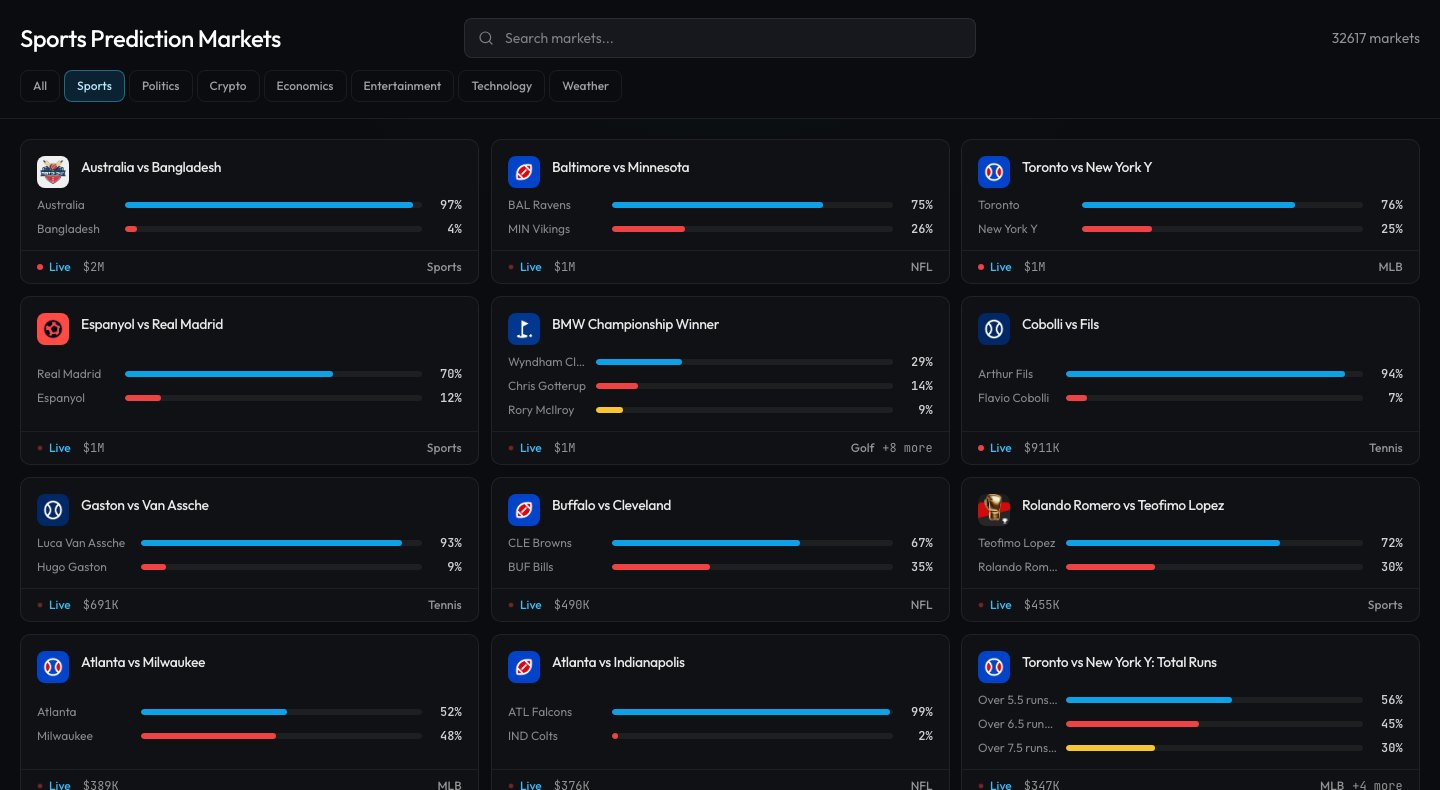
Research a live event
Browse active sports, politics, economics, crypto, technology, entertainment, and weather markets using current event prices.
Kalshi Markets
Many traders want a way to prove they can forecast and manage risk on Kalshi markets before putting personal capital at stake. PropTide gives that skill a structured evaluation path.
In brief
The facts to understand before comparing account sizes or paying for an evaluation.
PropTide is independent from Kalshi; it uses Kalshi market data and outcomes to operate its own evaluations and funded accounts.
Event contracts settle between $0 and $1, so contract count—not only purchase cost—determines the maximum swing of a position.
Live prices, spreads, fees, settlement, and event concentration all affect evaluation performance.
The operating model
01
Browse active sports, politics, economics, crypto, technology, entertainment, and weather markets using current event prices.
02
Buy Yes or No when your estimated probability differs enough from the available price to cover uncertainty, spread, and fees.
03
PropTide groups related contracts by event for risk limits. Multiple outcomes in the same event remain one concentration decision.
01
PropTide is not Kalshi and does not offer a Kalshi brokerage account. It is an independent evaluation and funded-trading platform whose market catalog, pricing, and settlement references are powered by Kalshi data. A PropTide user trades inside PropTide under PropTide's account rules.
That distinction matters. Account access, evaluation fees, funded payouts, support, and risk decisions are governed by PropTide's terms. Market outcomes and quoted probabilities originate from the underlying event-market structure.
02
A Yes contract quoted at 42¢ costs roughly $0.42 before fees and settles at $1 if the event resolves Yes or $0 if it resolves No. A No contract expresses the opposite outcome. Unlike a stock, the contract has a fixed settlement range and a defined event resolution.
Cheap contracts are not automatically low risk. Buying 500 contracts at 10¢ costs about $50 before fees, but those contracts can increase account value by as much as $450 if they settle at $1. That is why PropTide caps contracts per event rather than relying only on dollars spent.
03
PropTide applies the published Kalshi-style maker or taker fee calculation during evaluations. The taker formula is 0.07 × contracts × price × (1 − price), with price expressed as a decimal and the result rounded up to the next cent. Resting orders use the lower published maker coefficient.
For 100 contracts at a 40¢ price, the taker calculation is 0.07 × 100 × 0.40 × 0.60, or $1.68. The trader's forecast needs enough advantage to absorb that fee, the bid-ask spread, and the chance that the estimate is wrong. Evaluation P&L is measured after fees for precisely this reason.
04
Prediction markets can gap when news arrives, and some contracts become thin before resolution. PropTide monitors quote freshness when valuing open positions and does not confirm a drawdown breach using unreliable pricing. Final settlement follows the reported market outcome.
Related outcomes are grouped at the event level. Buying several candidates in one election or several thresholds tied to the same economic release does not create independent risk. Contract limits are designed around that shared event exposure.
Current rules
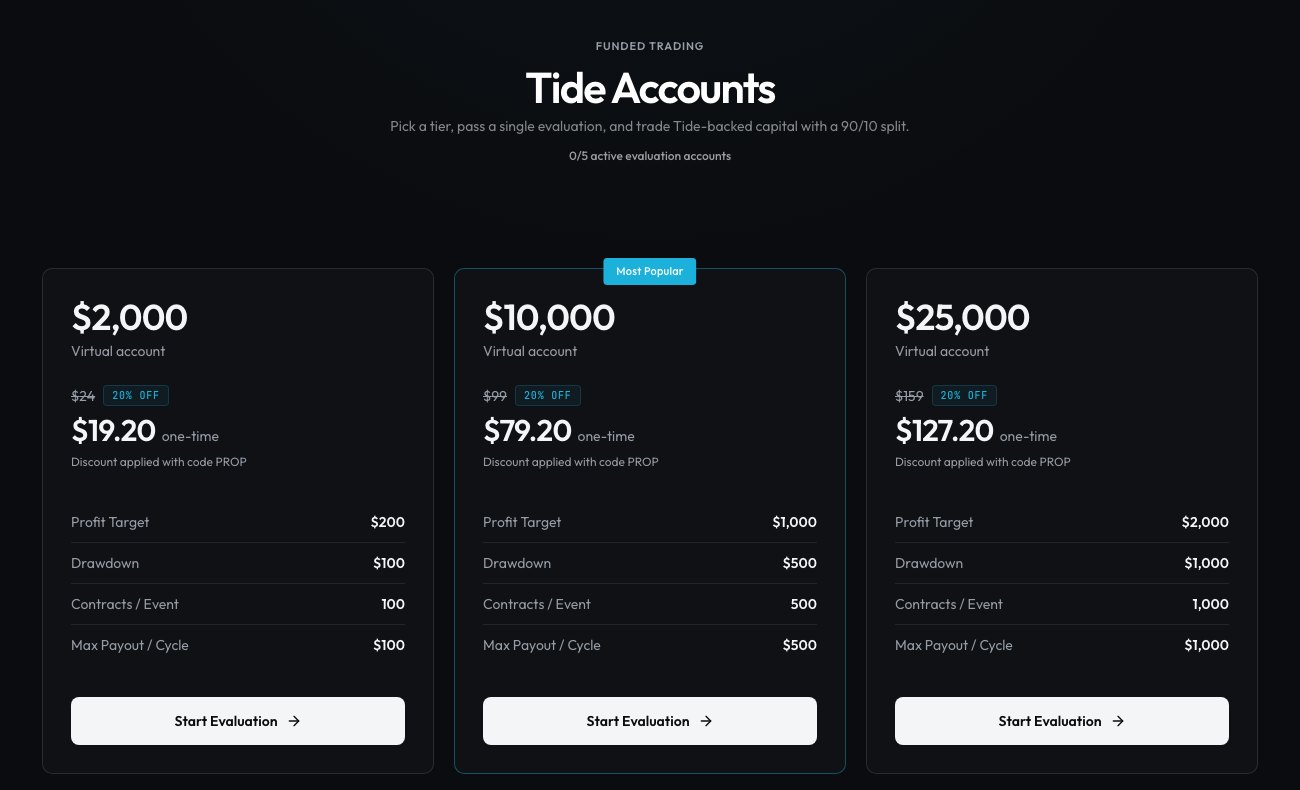
| Account | Fee | Target | Drawdown | Profitable day | Contracts / event | Cycle max |
|---|---|---|---|---|---|---|
| $2,000 | $24 | $200 | $100 | $50 | 100 | $100 |
| $10,000 | $99 | $1,000 | $500 | $250 | 500 | $500 |
| $25,000 | $159 | $2,000 | $1,000 | $500 | 1,000 | $1,000 |
Fees shown are standard list prices before any valid checkout discount. Rules are summarized; the complete rulebook controls.
Economics
For 100 contracts at 40¢, the published evaluation formula is 0.07 × 100 × 0.40 × 0.60.
$1.68
Fees are rounded up to the next cent. A supported resting order uses the lower maker coefficient; actual fills determine which rate applies.
Try the prediction market fee calculatorAt a $10,800 balance with $800 net realized profit and no prior payouts, the 90% entitlement is $720. The excess-balance cap is $400, the cycle ceiling is $500, and the withdrawal buffer leaves $300 available.
$300 after applying all amount limits
Assumes the account also meets winning-day, consistency and timing requirements. The 90% share is applied before the caps, not again after them.
Show the math
A trader buys 100 Yes contracts at 40¢ and later closes them at 55¢ using marketable orders.
This simplified example demonstrates why the displayed price move and account P&L are not identical. Actual fills, order type, rounding, and current fee rules determine the ledger result.
Inside the product
| Compare | Direct market account | PropTide evaluation |
|---|---|---|
| Starting capital | Trader deposits personal capital | Trader pays an evaluation fee for a virtual tier |
| Risk | Personal deposited capital | Evaluation attempt and published rule limits |
| Progression | No qualification phase | Pass one phase to unlock a funded account |
| Payout model | Trader owns direct account result | Eligible funded profits use a 90/10 split |
Check the trade
See how entry and exit fees change a trade's profit in a PropTide evaluation. Start with 100 contracts bought at 40¢ and sold at 55¢, or enter your own example.
Net result after trading fees
$11.58
Taker means an immediate fill; maker means a resting fill. Assumes one fill on each side with the selected fee rate, maker fees enabled, and no slippage. Multiple fills can round differently. Enter the price of the contract you buy, whether Yes or No. This estimates trade economics, not account eligibility or a payout.
Check PropTide's complete account rulesNo. PropTide is an independent funded prediction market platform that builds evaluations and challenges around Kalshi-powered market data.
Yes. PropTide focuses on prediction market trading, evaluation rules, leaderboards, and funded-account progression.
No. PropTide is an independent platform that uses Kalshi-powered market data and settlement outcomes.
A PropTide evaluation is created and traded inside PropTide. Review PropTide's current eligibility and account requirements before starting.
Binary markets settle according to their published rules. Some scalar market structures may report a settlement value; PropTide follows the supported market's reported outcome.
Every binary contract can move through a $1 settlement range. Contract counts therefore bound both potential upside and downside more consistently than purchase cost alone.
Compare the current tiers, then read the complete evaluation and funded-account rulebook.