01
The firm defines the mandate
The platform publishes the eligible markets, target, drawdown methodology, position limits, prohibited behavior, and payout terms.
Prop Firm Model
Traditional prop firms test traders on forex, futures, or equities. A prediction market prop firm applies the same prove-your-edge model to event contracts and real-world forecasts.
In brief
The facts to understand before comparing account sizes or paying for an evaluation.
A prediction market prop firm evaluates forecasting and risk management before allocating a funded trading account.
The important comparison points are market source, drawdown method, concentration limits, fees, payout rules, and evidence that the product operates as described.
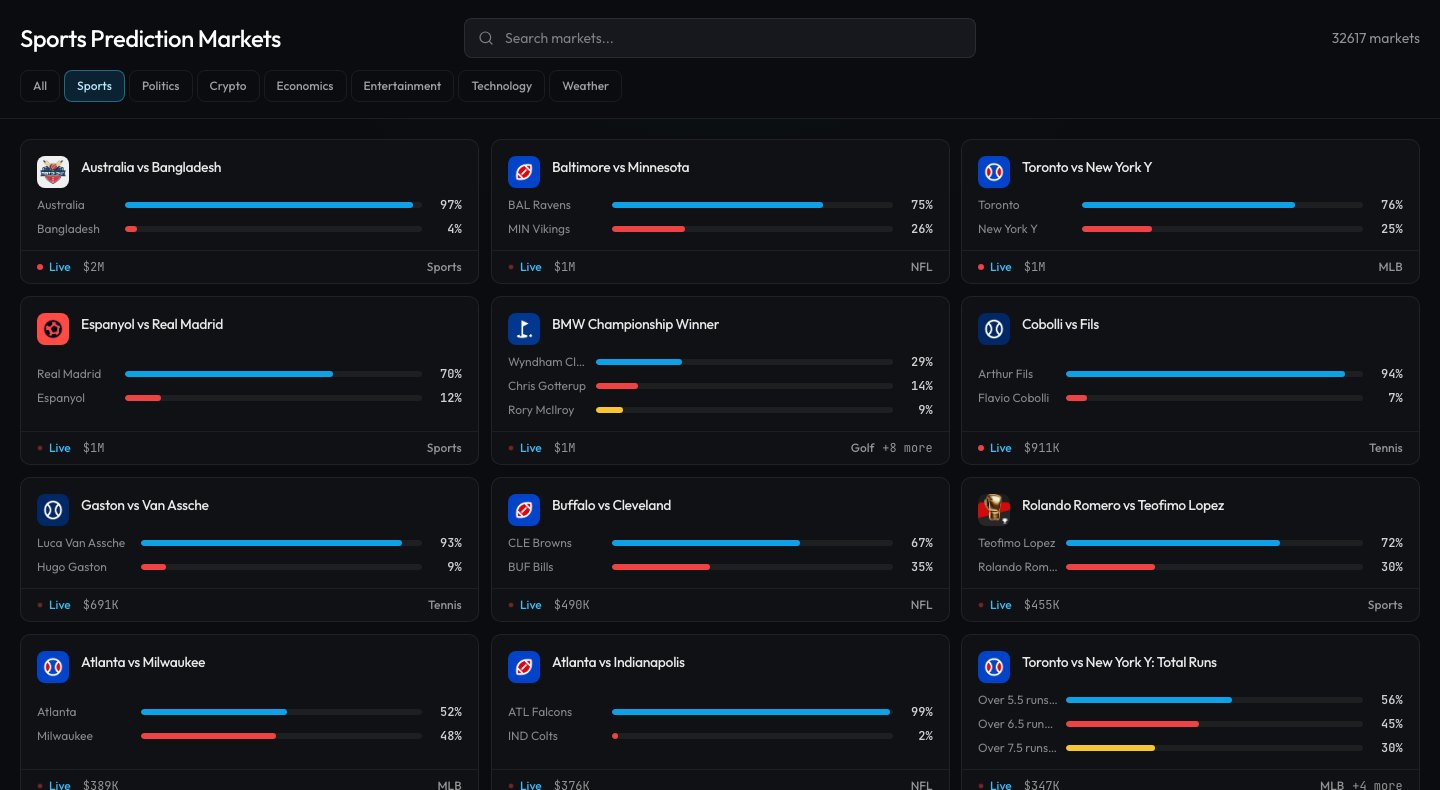
PropTide uses one evaluation phase, live Kalshi prices, three profitable days, and a 90% trader share of eligible funded profits.
The operating model
01
The platform publishes the eligible markets, target, drawdown methodology, position limits, prohibited behavior, and payout terms.
02
The evaluation tests whether a trader can generate net profit across multiple days while staying inside the risk envelope.
03
A qualified trader receives a funded account and participates in eligible net profits under the published split and payout schedule.
01
A prediction market prop firm is a company that evaluates traders on event contracts and provides qualified traders with a funded account. The trader typically pays for an evaluation rather than depositing the account's headline balance. Passing depends on both profitability and compliance with risk rules.
The model borrows the evaluation structure used in futures and foreign-exchange prop firms, but the trading problem is different. Event contracts have binary or scalar settlement, news-driven jumps, discrete resolution rules, and clusters of related outcomes. A credible rulebook must account for those characteristics directly.
02
During evaluation, the firm measures performance on a virtual account. Traders who hit the target without breaching the rules can activate a funded phase. The firm controls the risk envelope and retains a stated share of eligible funded profits; the trader receives the remainder through the payout process.
This is not the same as receiving an unrestricted cash loan. The funded account remains subject to market eligibility, drawdown, concentration, consistency, and payout requirements. Traders should judge the product by the complete rules—not the account-size headline alone.
03
A 10¢ contract can lose only its purchase price for a long Yes holder, but it can gain 90¢ at settlement. A dollar-spend limit would allow a large number of cheap contracts and an account-changing outcome. Contract-based caps constrain the full settlement swing more consistently.
Related contracts also require event-level aggregation. Ten candidate contracts in one election are ten instruments but one underlying event. PropTide counts exposure by event and maintains a total-open-contract ceiling in addition to the per-event cap.
04
Read the current rules, terms, refund policy, payout eligibility, geographic availability, and prohibited strategies. Confirm whether prices come from a live external market or a synthetic feed, how fees are charged, and whether open positions count toward drawdown.
Look for verifiable product behavior: public rule pages, functioning market access, responsive support, independent customer discussion, and a clear company identity. Be cautious when a site relies on invented activity numbers, hides its risk rules until checkout, or describes a funded balance as if it were cash handed directly to the trader.
Current rules
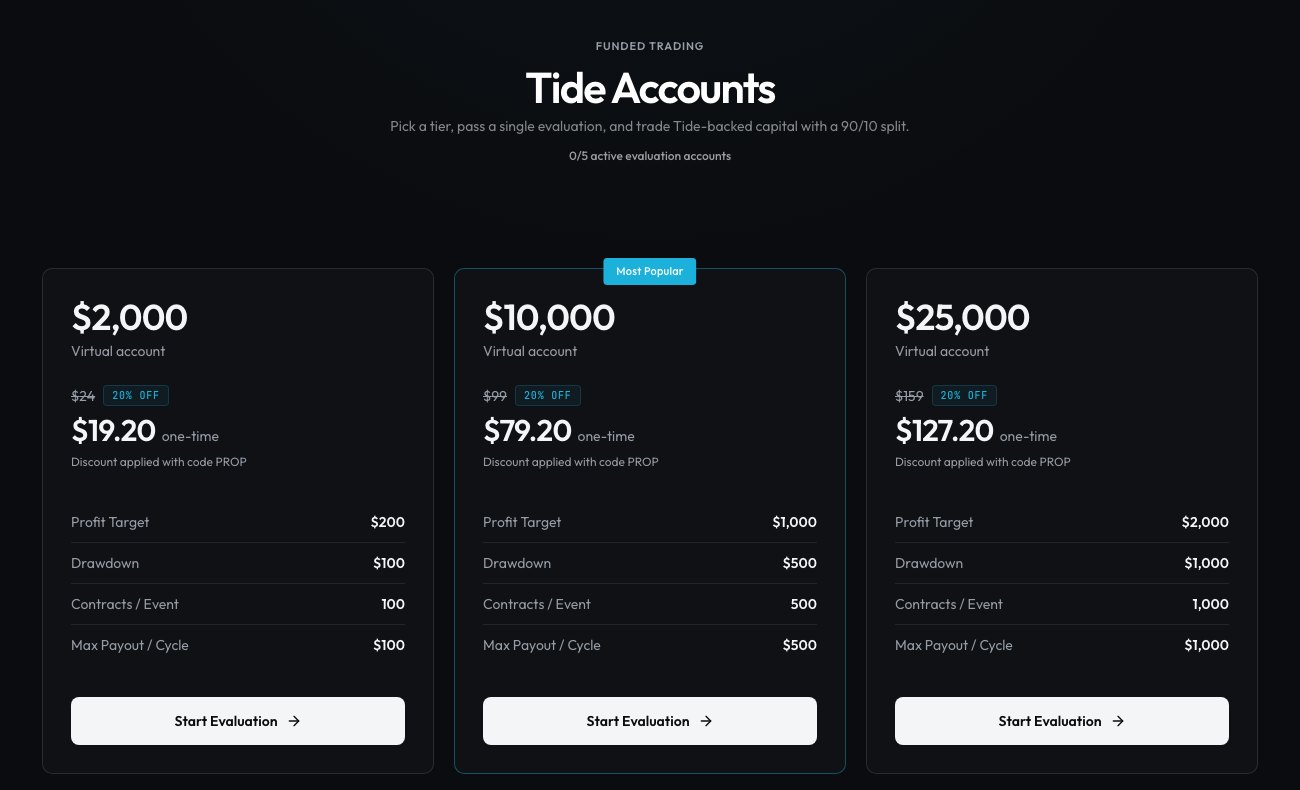
| Account | Fee | Target | Drawdown | Profitable day | Contracts / event | Cycle max |
|---|---|---|---|---|---|---|
| $2,000 | $24 | $200 | $100 | $50 | 100 | $100 |
| $10,000 | $99 | $1,000 | $500 | $250 | 500 | $500 |
| $25,000 | $159 | $2,000 | $1,000 | $500 | 1,000 | $1,000 |
Fees shown are standard list prices before any valid checkout discount. Rules are summarized; the complete rulebook controls.
Economics
For 100 contracts at 40¢, the published evaluation formula is 0.07 × 100 × 0.40 × 0.60.
$1.68
Fees are rounded up to the next cent. A supported resting order uses the lower maker coefficient; actual fills determine which rate applies.
Try the prediction market fee calculatorAt a $10,800 balance with $800 net realized profit and no prior payouts, the 90% entitlement is $720. The excess-balance cap is $400, the cycle ceiling is $500, and the withdrawal buffer leaves $300 available.
$300 after applying all amount limits
Assumes the account also meets winning-day, consistency and timing requirements. The 90% share is applied before the caps, not again after them.
Show the math
Consider a trader selecting the current $2K PropTide evaluation.
If the trader reaches a $2,200 balance after fees and completes the three qualifying days without a confirmed rule breach, the evaluation can pass. Funded activation and funded-phase rules then apply.
Inside the product
| Compare | Prediction-market model | Traditional trading model |
|---|---|---|
| Instrument | Event contracts tied to real-world outcomes | Commonly futures, FX, equities, or CFDs |
| Primary research | Probabilities, news, resolution criteria | Price action, macro, order flow, fundamentals |
| Concentration | Related outcomes grouped by event | Often grouped by symbol or asset class |
| Settlement | Defined event outcome, usually $0 or $1 | Position closed or marked continuously |
| Shared requirement | Profitability inside published risk limits | Profitability inside published risk limits |
PropTide structures its product as evaluations, challenges, and funded accounts with published terms. Availability and rules can vary by jurisdiction and product design.
The core qualification model is similar, but the underlying markets are event contracts and predictions rather than currency pairs or futures charts.
Not necessarily. PropTide is an evaluation and funded-account platform, not the underlying prediction-market exchange.
No. A funded account has a stated balance and remains subject to its drawdown, contract, consistency, and payout rules.
Compare the target, drawdown calculation, minimum days, market source, fees, contract limits, payout buffer, profit split, support, and current terms.
It can, but only when paired with execution and risk control. A correct forecast can still lose money if the entry price, sizing, fees, or timing are poor.
Compare the current tiers, then read the complete evaluation and funded-account rulebook.